
 By
By 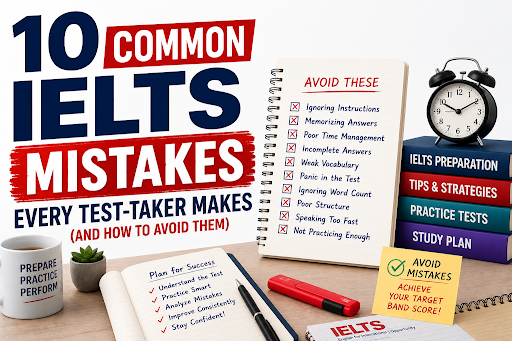
IELTS exam is the popular English language proficiency test. The candidates who want to study or work abroad must give this test and achieve the desired score. Even students with good English skills can make some common mistakes, and it affects their stress. It is due to the lack of format understanding, exam strategy, and guidance. Test takers are recommended to follow with proper preparation and a study plan, and avoid such mistakes.
Common IELTS Mistakes to Avoid
Here are the 10 most common IELTS mistakes every test-taker makes and practical strategies to avoid them.
1. Ignoring Test Instructions
The Mistake
One of the common mistakes candidates make is ignoring test instructions. For example, in the Reading and Listening sections, you may be told to write “No more than two words” or “One word and/or number.”
Many candidates miss easy points by writing answers that exceed the word limit or by using the wrong format. Sometimes, students write “True” instead of “Yes” or “False” instead of “No,” even though the question asks for specific responses.
How to Avoid It
it is suggested to read the instructions completely before answering any question. You should check the word limits, number requirements, spelling accuracy, and answer formats. Even a correct answer can be marked wrong if it does not follow the instructions exactly.
2. Using Memorized Templates in Writing and Speaking
The Mistake
Many students think that memorizing complex introductions, conclusions, or speaking scripts will help them get a higher band score. Unfortunately, IELTS examiners know how to spot memorized responses. So relying too much on templates can make answers unnatural and repetitive. It also limits your ability to respond to unexpected questions.
How to Avoid It
Don’t memorize full responses. Instead, focus on developing flexible language skills. Practice expressing your ideas naturally on different topics by regularly taking an IELTS practice test and reviewing your performance.
Learn useful connectors such as furthermore, however, in addition, and as a result, and use them appropriately rather than forcing them into every sentence. Combining regular IELTS practice tests with natural speaking and writing practice will improve your confidence and help you communicate more effectively. Natural communication always scores better than rehearsed speeches.
3. Poor Time Management
The Mistake
Test takers make the biggest mistake by spending too much time on a single question, and then rush in remaining. In the writing section, some write too much for Task 1 and run out of time for Task 2, and lose marks.
How to Avoid It
It is suggested to practice under timed conditions regularly. Divide your time wisely: for example, in Writing, spend 20 minutes on Task 1 and 40 minutes on Task 2. If you find a difficult question, then move on and come back to it later if time allows.
4. Not Answering All Parts of the Question
The Mistake
Candidates only answer part of the question in the Writing and Speaking section. For example, the Writing Task 2 question might ask, “Discuss both views and give your opinion.” Then some students discuss both views, but do not clearly state their own opinion. Similarly, in Speaking Part 3, candidates may answer the first part of a question but ignore the follow-up aspect.
How to Avoid It
identify the complete requirement in each task. You should ask yourself
- What exactly is being asked?
- How many points do I need to address?
- Have I answered all parts?
By understanding complete requirements, you can answer the full task and boost your task response and Task Achievement scores.
5. Weak Vocabulary and Repetition
The Mistake
Students repeat the same simple words (like good, bad, big, small) in essays and speaking.
How to Avoid It
To avoid this mistake, you should learn the synonyms and phrases for common words. It helps you to build your vocabulary. You should also practice by using new words in sentences, not just memorizing them.
6. Panicking During the Listening Test
The Mistake
Many candidates panic when they miss an answer in listening. Rather than focus on ongoing recording, they keep thinking about the missed question and miss more answers. It affects the final score.
How to Avoid It
Stay calm, even if you miss the answer. You should move on to the next question and continue following the recording.
7. Poor Paragraph Structure in Writing
The Mistake
Some candidates write long blocks of text without proper paragraph separation. Others create too many short paragraphs that affect the flow of ideas. Poor organization makes essays hard to follow and affects cohesion and coherence scores.
How to Avoid It
You should use a clear and logical essay structure. Follow the reliable writing task 2 format, which includes an introduction, body Paragraph 1, body Paragraph 2, and a conclusion. You should summarize the discussion and restate your opinion properly.
A well-organized essay is easier for examiners to read and evaluate positively.
8. Ignoring the Word Count
The Mistake
Writing less than the word count is another mistake candidates make. Missing the word count of task 1 ( 150 words ) and task 2 ( 250 words) lowers your score.
How to Avoid It
Candidates should practice writing under timed conditions. You should estimate your writing length by counting average lines and words during practice sessions. aim for around 170–190 words for Task 1 and around 270–290 words for Task 2. It gives you a safe margin above the minimum without wasting valuable time.
9. Speaking Too Fast or Monotonously
The Mistake
Speaking too fast shows your nervousness and makes pronunciation unclear. Some candidates rely on memorized responses and speak in a flat tone, which shows a lack in natural expression. These mistakes affect fluency and pronunciation scores.
How to Avoid It
You should treat a speaking test as a conversation instead of an interview. You should focus on clear speaking, maintain a natural pace, use varied intonation, and expand your answers with examples. Focus on Confidence and clarity rather than speed, and get a higher band score in speaking.
10. Not Practice Under Real Exam Conditions
The Mistake
Many students prepare using short exercises and untimed practice sessions. While these activities help build skills, they do not prepare candidates for the pressure and timing of the actual exam. As a result, even well-prepared students may struggle on test day.
How to Avoid It
It is suggested to include the regular full-length IELTS mock test in your preparation schedule. You should practice under timed conditions, use authentic IELTS materials, and follow the official exam rules. It helps you to simulate the real test conditions, improves endurance, confidence, and time management skills.
Conclusion
Getting success in IELTS is not only about avoiding common mistakes but also understanding how exams work and excels in all sections. Many candidates remain stuck at Band 6 or Band 6.5 because they repeatedly make the same strategic mistakes rather than addressing their weaknesses.
By making sure to avoid the above mistakes, managing your time well, organizing your writing properly, speaking naturally, and practicing under realistic conditions, you can avoid the most common IELTS pitfalls and maximize your performance.
FAQs
Q1. Is it hard to pass IELTS?
No, it is not always hard to pass the IELTS test. It depends on your knowledge and preparation. With the right guidance and strategies, you can take the IELTS test and achieve a higher score.
Q2. What are the common mistakes in the IELTS test?
The common IELTS mistakes are not answering all parts of writing, poor time management in reading and listening, and mispronouncing words in speaking, which affect your score.
Q3. How to avoid mistakes in IELTS writing?
to avoid common writing mistakes, you should answer essays in the given word limit. Practice writing essays as much as you can to improve your skills.
Q4. How to improve fluency in IELTS speaking?
To improve fluency in IELTS speaking, practice speaking daily, use vocabulary properly, and avoid memorized answers.
Q5. Is it better to use simple vocabulary in IELTS?
Yes, it is good to use simple vocabulary in IELTS tests using difficult words incorrectly. Clear communication helps you to focus on the test and score better.

















Comments