
 By
By 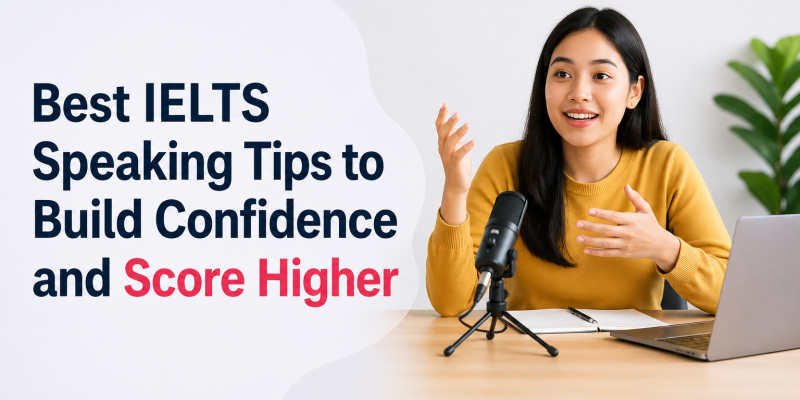
The IELTS speaking test evaluates your skills to communicate in English. Confidence and natural speech play a vital role to achieve a high score. Many candidates struggle with unnatural pauses, hesitation and monotonous tone, which reduce their fluency and coherence scores. So in this blog, we tell you the tips to build your confidence in IELTS speaking and score good.
Tips to Build Confidence in IELTS Speaking
Speaking is the most nerve-racking part of the IELTS exam for many candidates. It is a face to face test with an examiner and leads to anxiety among test takers. So it is important to build your confidence to perform well in it. Here are the 10 tips you can follow
1. Record Voice While Practicing
Improve your speaking by recording your voice and analysing it for improvements. You can easily download a sound record app to record your speaking and start practicing well. You can keep a full speaking test or a cue card in front of you to speak focused and confidently.
After every recording, play it and analyze it for grammar, fluency, tense and vocabulary. Now notice how long you spoke and whether you have hesitations or not. With these free ielts practice tips, you can gain your confidence and stay ready for exam day without stress.
2. Expand Vocabulary
Having a strong vocabulary is important to express your ideas and speak confidently. Here’s how you can expand your vocabulary
- Learn the topic-related words used in IELTS Speaking, like technology, education and environment.
- Use synonyms to avoid repeating the same word
- Practice by using phrasal verbs and idioms in a natural way
For example, rather than saying, “I am very happy,” you can say, “I am over the moon.”
3. Develop Fluency Through Practice
To build your confidence in the speaking section, you must do consistent practice and develop your fluency. Do speaking practice daily. Listen to native speakers properly and repeat the sentences right away to know accuracy. Record yourself while speaking and check your fluency.
Schedule the mock interviews with your teachers, friends and language partners. Use the online platforms to talk with native speakers and improve your fluency.
4. Master Intonation and Pronunciation
It is also important to excel in Intonation and Pronunciation to build confidence in IELTS speaking. It is suggested to pay attention to word stress, like PHO-to-graph vs. pho-TO-graph-y.
Practice intonation and avoid sounding mechanical. Use the online dictionaries and pronunciation apps that give you audio pronunciation. Imitate native speakers by listening to podcasts and watching English movies.
5. Avoid Memorized Answers
Don’t use the rehearsed responses, because examiners can catch you instantly. Rather than memorizing answers, you have to practice speaking on different topics, and become familiar with them.
You have to organize your answers logically rather than rely on learned phrases. Improvise or learn to rephrase while discussing common topics. It is suggested to practice answering surprise questions to boost your adaptability.
6. Try to Speak More and More
In IELTS speaking, don’t be frustrated by the examiner. Stay calm and try to elaborate on your answers. Rushing can cause many mistakes, and speaking too slowly can make you less confident.
So don’t doubt yourself, even if you think you are making mistakes. Just keep talking at a consistent speed and cover this section confidently.
7. Use Fillers Naturally (Not Excessively)
To seem confident in the IELTS speaking test, you should use the fillers naturally. Use fillers like “Well,” “You know,” or “Actually” naturally. Avoid using too much, because it makes you sound unsure. Use fillers in a moderate range and keep your conversation flowing.
You can also use the Substitute fillers with meaningful transitions like “Let me think about that” or “That’s an interesting question”.
8. Confident Eye Contact and Body Language
IELTS Speaking is not graded on body language, but eye contact and proper gestures also boost your confidence. It is suggested to use slight hand gestures to make your speech more confident and engaging. Don’t use excessive fidgeting; it shows your nervousness.
Practice speaking in front of a mirror to see and enhance your body language.
9. Structure Your Answers Clearly
To score high in speaking, you should practice structuring answers clearly. Here’s how you can structure it
- Use the O.R.E.O. method: Opinion, Reason, Example, Opinion restated.
- For Part 2 (long turn), follow the cue card structure clearly.
- For Part 3, support your answer with detailed information.
- Avoid one-word or very short answers — expand on your ideas.
- Use transition words like “Firstly,” “In addition,” and “For example” to organize your responses.
10. Take Mock Speaking Tests Regularly
Practice with mock tests builds your confidence, makes you familiar with real speaking test conditions and improves you. You have to set a timer and record yourself while answering various questions.
Practice with your study partner and tutor to get feedback. Take the AI-powered IELTS Speaking mock tests to get instant feedback. Mock tests build your confidence and prepare you for a real test environment.
Conclusion
Confidence in the IELTS Speaking test comes from regular practice, structured answers, vocabulary improvement, and simulations of real-life speaking. By following these strategies, daily practice, improving pronunciation, taking mock tests and structuring responses, you can overcome your stress and speak fluently.
FAQs
Q1. How to improve my confidence for IELTS Speaking?
Ans: Practice speaking English daily in real life, review it, and record your responses. Take the mock tests and put yourself in real speaking situations to improve your confidence.
Q2. Is grammar important in IELTS Speaking?
Ans: Yes, grammar is important in the speaking section, but you have to focus on your fluency also. Use the correct basic structure while speaking. Keep a balance of accuracy and smooth communication to achieve a higher band score.
Q3. Can I ask the examiner to repeat the question?
Ans: Yes, you can ask the examiner to repeat or clarify a question in the speaking session. It does not affect your score and shows that you are attentive and want to respond properly to the examiner.
Q4. How long should my answers be?
Ans: Your answers must be detailed enough to show your vocabulary and fluency. Avoid short responses, Includes examples, explanations and personal experiences to make your answers complete and engaging.
Q5. What if I make a mistake while speaking?
Ans: If you make a mistake in IELTS speaking, then don’t panic or stop speaking. Try to correct yourself and keep going confidently. Examiners appreciate your communication skills, so maintain clarity and fluency to get a higher score successfully.
















Comments